Magnesium Oxide
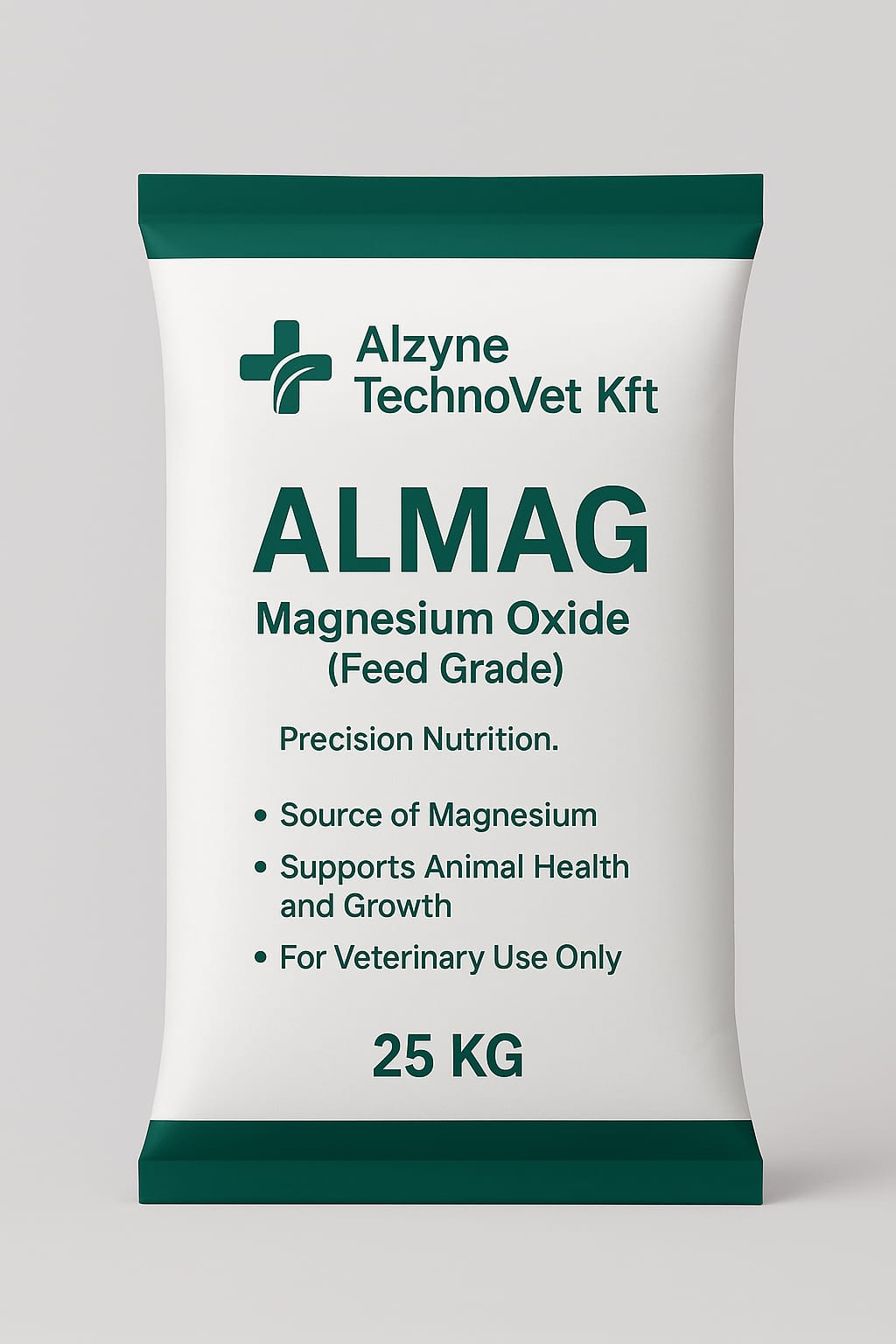
ALMO Magnesium Oxide Feed Grade
Introduction
Magnesium oxide feed grade is an essential mineral supplement widely used in the livestock and poultry industries. It serves as a source of magnesium, which is critical for various metabolic processes in animals.
This high-quality feed additive helps to prevent magnesium deficiency, promoting overall health and improving the growth rate and feed efficiency of livestock. Additionally, magnesium oxide feed grade is highly soluble and easily absorbed, making it an effective solution for enhancing the nutritional value of animal diets.
Farmers and producers often incorporate it into their feed formulations to ensure their animals receive adequate levels of this vital nutrient, ultimately contributing to better productivity and animal welfare. With its broad applications, magnesium oxide feed grade plays a significant role in sustainable animal husbandry practices.
Certificate Of Analysis
NAME | MagnesiumOxide | PRODUCTION DATE | 2025.06.16 | |||||
BATCHNO. | 20210616 | PACKAGE | 25Kg/package | |||||
Standard: | As company | QUANTITY | 106T | |||||
INSPECTION DATE | 2025.06.16 | INSPECTION CONDITION | TEMPERATURE : 25℃ HUMIDITY:55% | |||||
PERIOD OF VALIDITY | 2028.06.15 | SPECIFICATIONS AND MODELS | Fine White Powder | |||||
INSPECTION ITEM | QUALITY STANDARD | RESULT | INSPECTION RESULT | |||||
Magnesium Oxide% | ≥90.00 | 92.3 | Qualified | |||||
Calcium Oxide% | ≤2.0 | 1.53 | Qualified | |||||
Moisture% | ≤2.0 | 0.5 | Qualified | |||||
Sulfates% | ≤0.7 | 0.1 | Qualified | |||||
Loss on Ignition% | ≤10.0 | 3.8 | Qualified | |||||
Fe2O3% | ≤0.7 | <0.01 | Qualified | |||||
Al2O3% | ≤0.1 | <0.1 | Qualified | |||||
SiO2% | ≤1.0 | 0.07 | Qualified | |||||
Size% | D97 | 200mesh | Qualified | |||||
Bulk Density | g/cm³ | -- | 0.59 | Qualified | ||||
Specific gravity | -- | 3.61 | Qualified | |||||
Whiteness% | ≥95 | 97 | Qualified | |||||
Causticizing reaction% | ≥80 | Confirmed | Qualified | |||||
IQC | FANG YANG. | CHECKER | BILLY LIU. | APPROVER | BILLY LIU. | |||
Functions and Applications
1. Magnesium oxide is an excellent rumen buffer, which can regulate rumen fermentation, increase the absorption of breast milk synthetic precursors, and improve milk yield and milk fat rate. Adding magnesium oxide to dairy cows' diet can prevent heat stress. Magnesium ion can act together with sodium ion and potassium ion to maintain the balance of osmotic pressure inside and outside cells and alleviate the response of dairy cows to heat stress, so as to improve the feed intake of dairy cows in summer and maintain the milk yield. In addition, it is suggested that in the case of heat stress, the amount of magnesium oxide in the diet should be increased to make up for the loss of magnesium in the body, so as to ensure and maintain normal milk yield.
2. Poultry
The growth rate of broilers fed a diet containing 200 ppm magnesium decreased by 80% compared with a diet containing 600 ppm magnesium. For laying hens, properly increasing the concentration of magnesium in laying hens' diet can improve the quality of eggshell and egg weight.
3. Pigs
The lack of magnesium ion will greatly improve the mortality of piglets. The lack of magnesium will cause the gait disease of pigs, which is manifested as repeatedly lifting the hind hoof when the pigs stand as if they were standing still. For sows, magnesium oxide is widely used as a laxative to prevent stress syndrome such as hypersensitivity and tail biting in captive pigs.
Adding magnesium oxide or increasing the concentration of magnesium in the diet can improve the quality of pork. Feeding a diet supplemented with magnesium oxide can improve the growth rate and pork quality, including the pH value and color of pork, and reduce PSE pork.
4. Freshwater fish
The amount of dissolved magnesium in freshwater fish is insufficient, so it is necessary to supplement magnesium appropriately in feed.
Rumen buffer regulators in additives, such as sodium bicarbonate, magnesium oxide, etc.